
The employability paradox: Do investments in employees pay off?
Mojca Svetek | 12 March 2024
More employable workers are more productive and thus contribute more to organizational performance. However, employable workers, as the term implies, have more employment opportunities and are therefore more likely to leave their employer when new opportunities arise. Thus, although employers benefit from hiring productive individuals, they run the risk of losing their employees precisely because they are highly employable. This is known as the employability paradox.
Studies have linked employability to a lack of commitment to the employer and to the tendency to continue job search even while employed. This results in a greater probability of switching employers.
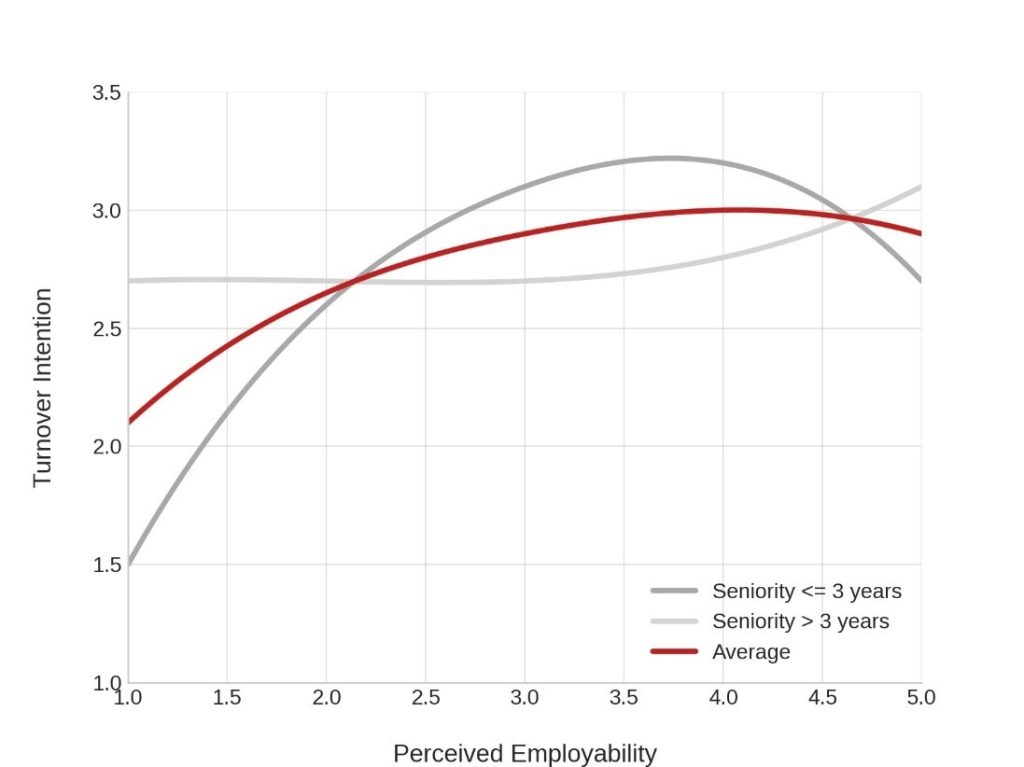
A lot of organizations worry that if they invest too much in their employees, it might lead to higher turnover. But what if the key to retaining the best employees is actually to invest more in them? Highly employable individuals are more likely to consider leaving if they feel that their skills and talents are being underutilized and overlooked. On-the-job training can actually show employees that the organization values their growth and offers opportunities for career advancement within the company. This is especially appealing to highly employable individuals who are more likely to respond positively to such development opportunities. And in return, they might be less likely to leave the organization.
There are a couple of reasons why investing more in the most employable might work. First, employees recognize and value the commitment of their employer to their career development. In this case, they reciprocate with greater commitment to the organisation. Second, studies have shown that on-the-job training provided by the employer tends to boost prospects within that specific organization rather than across different organizations. On-the job training is usually provided to improve skills needed in a current role that are not always transferable to other jobs. Individuals who have skills that are a good match for their jobs are much more likely to stay in that job.
It seems like one of the ways for employers to combat the employability paradox is to invest in their employees, especially the most employable ones. This seems to create a win-win situation. Employees can envision a long-term career path within the organization and employers benefit from employees with updated skills tailored to the needs of their organization.
Research articles:
Akkermans, J., Tims, M., Beijer, S., & De Cuyper, N. (2019). Should employers invest in employability? Examining employability as a mediator in the HRM–commitment relationship. Frontiers in Psychology, 10, article 717.
Nelissen, J., Forrier, A., & Verbruggen, M. (2017). Employee development and voluntary turnover: Testing the employability paradox. Human Resource Management Journal, 27(1), 152-168.
Rodrigues, R., Butler, C. L., & Guest, D. (2020). Evaluating the employability paradox: When does organizational investment in human capital pay off? The International Journal of Human Resource Management, 31(9), 1134-1156.
Yu, H., Yan, C., Zhang, L., Dong, Z., Cheng, L., Zheng, X., & Zhao, Z. (2021). Does the employability paradox exist or not? An inverted U-shaped model. Frontiers in Psychology, 12, article 588793.