
Is temporary employment a stepping stone or a dead-end?
Mojca Svetek | 10 October 2023
Many policy makers see temporary work as a stepping stone to permanent employment, especially for the vulnerable groups. Temporary work may even be seen as an opportunity to gain work experience, acquire skills, and prove one’s productivity to employers.
But how temporary is temporary employment? As evidenced in our data, the conversion rates from temporary to permanent employment are low. Studies report than less than 15 % (in some contexts less than 10 %) of temporary employees manage to secure a permanent position a year latter. This indicates strong persistence of temporary employment. It is also important to realise that transitions from temporary to permanent employment most frequently occur with the same employer, not between firms. The reality is: Some employers view temporary positions as a screening mechanism for potential permanent hires, while the majority use them as a mere flexibility buffer. Consequently, temporary employees find themselves in a limited position when it comes to securing permanent jobs outside of their current employer.
In general, what needs to be understood about the labour market is that the labour market is sticky. Those who are unemployed now are most likely to be unemployed in the future. Temporary employees switching employers usually end up once again in temporary employment. Permanent employees switching employers usually end up in permanent employment.
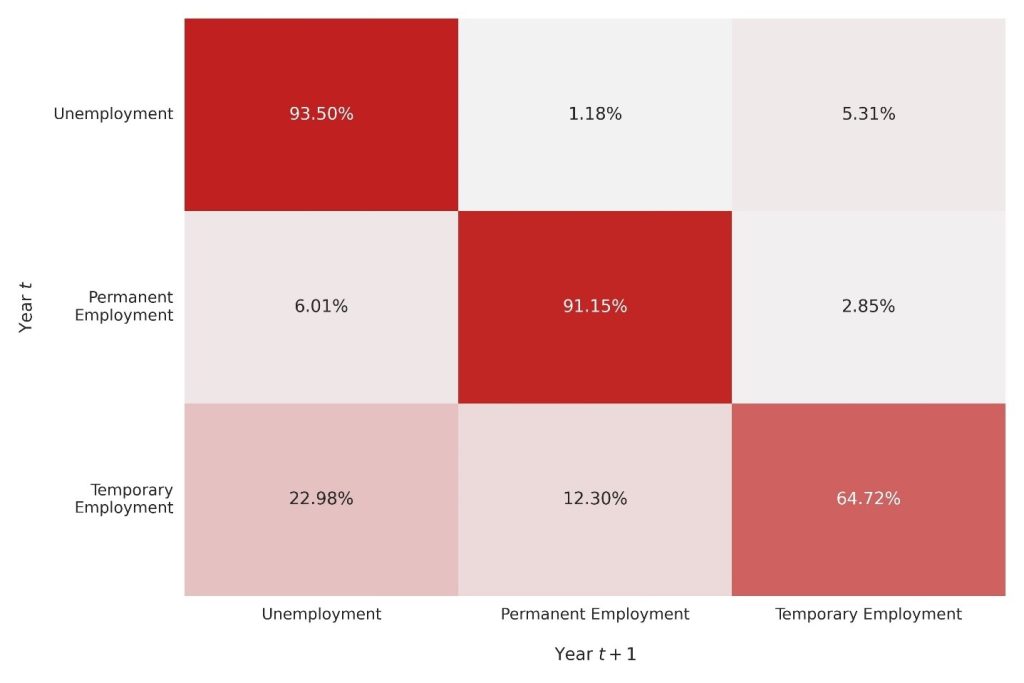
Temporary employment is indeed an advantage over unemployment in securing a permanent job. In comparison to the unemployed, those in temporary employment have a higher chance of transitioning to permanent employment by about 10 percentage points, 1 year later or 15 percentage points, 2 years later. Thus, holding a temporary job has some advantage in comparison to holding no job when it comes to transitioning into permanent employment.
However, this may be truer for some groups on the labour market than the others. Males from ethnic minorities, the low educated, and men in general are more likely to transition from temporary employment to permanent employment than are women, older people and those with disabilities. But let’s not get too optimistic. The reality is, the odds are still not particularly high for any of these groups. In fact, on average, someone in a temporary job is five times more likely to stay in that position rather than move into a permanent one. It’s safe to say that temporary employment is a dead end for most. Therefore, one of the challenges to address is actually how to facilitate transitions between temporary and permanent employment.
Research articles:
Berton, F., Devicienti, F., & Pacelli, L. (2011). Are temporary jobs a port of entry into permanent employment? Evidence from matched employer‐employee. International Journal of Manpower, 32(8), 879-899.
de Graaf-Zijl, M., van den Berg, G. J., & Heyma, A. (2011). Stepping stones for the unemployed: the effect of temporary jobs on the duration until (regular) work. Journal of Population Economics, 24(1), 107-139.
Fang, T., & MacPhail, F. (2008). Transitions from temporary to permanent work in Canada: Who makes the transition and why? Social Indicators Research, 88(1), 51-74.
Filomena, M., & Picchio, M. (2022). Are temporary jobs stepping stones or dead ends? A systematic review of the literature. International Journal of Manpower, 43(9), 60-74.
Güell, M., & Petrongolo, B. (2007). How binding are legal limits? Transitions from temporary to permanent work in Spain. Labour Economics, 14(2), 153-183.
Passaretta, G., & Wolbers, M. H. (2019). Temporary employment at labour market entry in Europe: Labour market dualism, transitions to secure employment and upward mobility. Economic and Industrial Democracy, 40(2), 382-408.
Picchio, M. (2008). Temporary contracts and transitions to stable jobs in Italy. Labour, 22, 147-174.
Rubery, J., Grimshaw, D., Keizer, A., & Johnson, M. (2018). Challenges and contradictions in the ‘normalising’ of precarious work. Work, Employment and Society, 32(3), 509-527.
Schmillen, A., & Umkehrer, M. (2017). The scars of youth: Effects of early‐career unemployment on future unemployment experience. International Labour Review, 156(3-4), 465-494.
Svalund, J., & Berglund, T. (2018). Fixed-term employment in Norway and Sweden: A pathway to labour market marginalization? European Journal of Industrial Relations, 24(3), 261-277.